Española Island (Hood Island) is named in honor of Spain. The English named it Hood Island. It has an area of 60 square kilometres (23 mi²) and a maximum altitude of 206 metres (676 ft). It is located in the extreme southeast of the archipelago and is considered, along with Santa Fe, one of the oldest, at approximately four million years. A popular tourist stop, Isla Española is the most southerly island in the Galápagos Archipelago. It is about a 10- to 12-hour trip by boat from Isla Santa Cruz. Tourists come to see the albatrosses and the mating dances of blue-footed boobies on Española Island. The island’s remote location has a large number of endemic fauna. Secluded from the other islands, wildlife on Española adapted to the island’s environment and natural resources. Marine iguana’s on Española are the only ones that change color during breeding season. The Waved Albatross is found on the island. The island’s steep cliffs serve as the perfect runways for these large birds which take off for their ocean feeding grounds near the mainland of Ecuador and Peru. Española has two visitor sites. Gardner Bay is a swimming and snorkeling site as well as offering a great beach. Punta Suarez has migrant, resident, and endemic wildlife including brightly colored Marine Iguanas, which have red markings on their backs, Española Lava Lizards, Hood Mockingbirds, which have a longer and more curved beak than the ones on the central islands, Swallow-tailed Gulls, Blue Footed Boobies and Nazca Boobies, Galápagos Hawks, a selection of Finch, and the Waved Albatross.
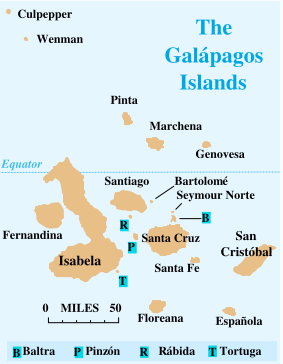
The Galápagos Islands (Official name: Archipiélago de Colón; other Spanish names: Islas de Colónumio or Islas Galápagos, from galápago, “saddle”—after the shells of saddlebacked Galápagos tortoises) are an archipelago of volcanic islands distributed around the equator, 965 kilometres (about 600 miles) west of continental Ecuador in the Pacific Ocean (1° S 91° W). The group consists of 13 main islands, 6 smaller islands, and 107 rocks and islets. The islands are located at a geological hot spot, a place where the earth’s crust is being melted from below by a mantle plume, creating volcanos. The oldest island is thought to have formed between 5 and 10 million years ago. The youngest islands, Isabela and Fernandina, are still being formed, with the most recent volcanic eruption in 2005. It is one of the few places in the world without an indigenous population. The Galápagos archipelago is a province of Ecuador, a country in northwestern South America, and the islands are all part of Ecuador’s national park system. They are famed for their vast number of endemic species and the studies by Charles Darwin during the voyage of the Beagle that contributed to the inception of Darwin’s theory of evolution by natural selection.
(Adapted from: Galapagos : Wikipedia, The Free Encyclopedia)
Click on any picture for a FREE larger version. Read the licensing rules (REVISED) for your needs. There are hundreds of high quality free photos: use the Google/site search engine. See our digital photography tips : DOs and Don’ts; Choosing a Camera and Accessories , Taking Digital Photos, Downloading Photos, and Editing Photos. Visit Climate Change Facts to see for yourself if you are at risk from global warming.


