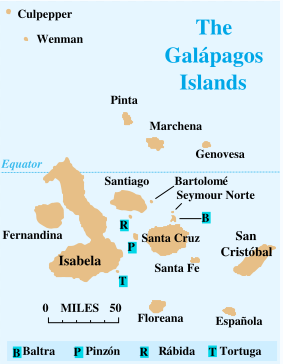
North Seymour is a small island near Baltra, Ecuador. It was formed as a result of the uplift of a submarine lava formation. The whole island is covered with low, bushy vegetation. Its name was given after an English nobleman called Lord Hugh Seymour. It has an area of 1.9 km² and a maximum altitude of 28 metres. This island is home to a large population of blue-footed boobies and swallow-tailed gulls. It hosts one of the largest populations of frigate birds.
The visitor trail on North Seymour is approximately 2 km in length crossing the inland of the island and exploring the rocky coast.
The Galápagos Islands (Official name: Archipiélago de Colón; other Spanish names: Islas de Colónumio or Islas Galápagos, from galápago, “saddle”—after the shells of saddlebacked Galápagos tortoises) are an archipelago of volcanic islands distributed around the equator, 965 kilometres (about 600 miles) west of continental Ecuador in the Pacific Ocean (1° S 91° W). The group consists of 13 main islands, 6 smaller islands, and 107 rocks and islets. The islands are located at a geological hot spot, a place where the earth’s crust is being melted from below by a mantle plume, creating volcanos. The oldest island is thought to have formed between 5 and 10 million years ago. The youngest islands, Isabela and Fernandina, are still being formed, with the most recent volcanic eruption in 2005. It is one of the few places in the world without an indigenous population. The Galápagos archipelago is a province of Ecuador, a country in northwestern South America, and the islands are all part of Ecuador’s national park system. They are famed for their vast number of endemic species and the studies by Charles Darwin during the voyage of the Beagle that contributed to the inception of Darwin’s theory of evolution by natural selection.