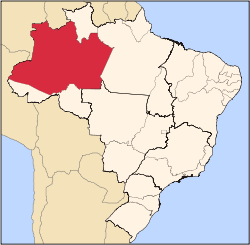
Manaus is a city in the northern part of Brazil and capital of Amazonas State. Located on the Rio Negro near its confluence with the Rio Solimões (also known as the Amazon River), it is the chief port and a hub for the region’s extensive river system. It is also a common point of departure for tourists visiting the rest of the Amazon region.
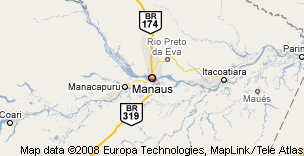
Situated on the banks of the Rio Negro (meaning Black River, because of the dark color of the water), Manaus is an important centre for ecological tourism. One of its most popular attractions is the Ponta Negra beach, 13 kilometres (8 miles) from the centre of the city, where, when the river is low, the sands are exposed right down to the river bed, forming a beautiful contrast with the dark waters of the river itself.
There is also the forested area of the National Research Institute of Amazônia (INPA), a complex made up of the Botanical Gardens, rich in plant species from the Amazon region, and the Zoological Gardens, which contain various animal species of the region, including some facing extinction.
The history of Manaus begins in an Indian village built around the São José da Barra Fortress, in 1669. A fortress had been constructed to prevent the descending of the Dutch invaders garrisoned in Suriname (former Dutch Guyana) and guarantee the domain of the Portuguese Crown in the region. The settlement that developed around the fortress was given the name of São José da Barra do Rio Negro (Lugar da Barra) and in 1832, under denomination of Nossa Senhora da Conceição da Barra do Rio Negro, the settlement was raised to the status of Villa (small town). In 1848, the small town of Vila da Barra was raised to the status of City, with the name Cidade da Barra do Rio Negro, finally receive the name Manaus, in 1856, to celebrate the Manáo (Mother of the gods) Indian nation, the most important ethnical group in the region, historically acknowledged by their courage and bravery. Between 1890 and 1910, thanks to the exportation of natural rubber, the local businessmen and rulers brought in from the Europe hundreds of architects and landscape painters, for the execution of an ambitious urban plan that would result in a city with European architectonic profile, though embedded in the middle of the jungle. Modern and innovative, Manaus was one of the first Brazilian cities to have electricity, pluvial drainage system, water treatment, sewer system and electric streetcar service. For over a hundred years ago Manaus inaugurated the Amazonas Opera House which astonished the world for its luxury, refinement and architectonic beauty, and in 1909 the first Brazilian University was founded – the Universidade Livre de Manaus (Autonomous University of Manaus). The floating harbor, built to adapt to the tidal water level of the rivers, was totally imported from England. Several other public buildings were also imported from England.
The old rubber barons dreamed of transforming Manaus into a European style city and called it “The Paris of the Tropics”. With the end of the rubber boom, Manaus went into decline and only entered a period of renewed development in the 1950s. A turning point was reached in 1967, when the Manaus Free Zone was established by the federal government. From that date on, the capital of Amazonas has passed through great changes, becoming an important industrial centre for the manufacture of electrical and electronic goods (nowadays, Manaus is the supplier for the entire country of items such as DVD players and computer monitors).
(Text and map of Brazil adapted from: Manaus (2008) in Wikipedia, The Free Encyclopedia)
Click on any picture for a FREE larger version. Read the licensing rules (REVISED) for your needs. There are hundreds of high quality free photos: use the Google/site search engine. See our digital photography tips : DOs and Don’ts; Choosing a Camera and Accessories , Taking Digital Photos, Downloading Photos, and Editing Photos. Visit Climate Change Facts to see for yourself if you are at risk from global warming.

%20in%20Manaus,%20Amazonas,%20Brazil&from=manaus-brazil-city)


%20in%20Manaus,%20Amazonas,%20Brazil&from=manaus-brazil-city)


%20in%20Manaus,%20Amazonas,%20Brazil&from=manaus-brazil-city)


