The Galápagos giant tortoise is the largest tortoise, endemic to nine islands of the Galápagos archipelago. Adults of large species can weigh over 300 kilograms (660 lb) and measure 1.2 meters (3.9 ft) long. Although the maximum life expectancy is unknown, the average is estimated at 200 years. The Galápagos tortoises have very large shells (carapace) made of bone which is an integral part of the skeleton. The bony plates of the shell are fused with the ribs and other bones to form a rigid protective structure. When a tortoise feels threatened it can withdraw its head, neck and forelimbs into its shell for protection, presenting a thick shield to a would-be predator. The legs have hard scales that provide an effective armour when withdrawn. The scutes of the carapace are not coincident with the underlying bony plates and grow at their outer edges. Tortoises thus keep their characteristic scute pattern throughout life. The shape of the carapace and other physical features correspond to the habitat of each of the 13 species. Larger islands with more wet highlands such as Santa Cruz and Isabela with lush vegetation near the ground have tortoises with ‘dome-back’ shells; these animals have restricted upward head movement due to shorter necks, and tend to have shorter limbs as well. These are the heaviest and largest of the subspecies. Smaller, drier islands such as Española and Pinta are inhabited by tortoises with ‘saddle-back’ shells comprising a carapace elevated above the neck and flared or reverted above the hind feet, and longer, thinner limbs allowing them to browse taller vegetation. On the drier islands with tortoise populations, the Galápagos Opuntia cactus (a major source of their water) has evolved a more tree-like and taller form, giving evidence of an evolutionary arms race between progressively taller tortoises and correspondingly taller cacti. Saddleback tortoises tend to be smaller than their domeback counterparts. The male is always larger than the female. Shells are either saddleback or domeback or of some combination. Most have a dull-brown colour.
Santa Cruz Island is one of the Galápagos Islands with an area of 986 km² and a maximum altitude of 864 metres. Named after the Holy Cross, its English name (Indefatigable) was given after a British vessel (HMS Indefatigable). Santa Cruz hosts the largest human population in the archipelago at the town of Puerto Ayora. The Highlands of Santa Cruz offer an exuberant vegetation and are famous for the lava tunnels and large tortoise populations . Black Turtle Cove is surrounded by mangroves which sea turtles, rays and small sharks sometimes use as a mating area. Cerro Dragón, known for its flamingo lagoon, is also located here, and along the trail one may see land iguanas foraging.
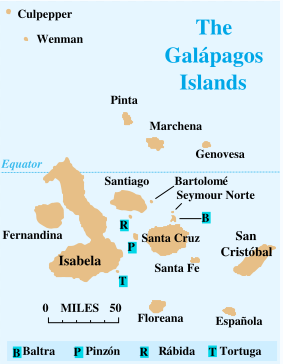
The Galápagos Islands (Official name: Archipiélago de Colón; other Spanish names: Islas de Colónumio or Islas Galápagos, from galápago, “saddle”—after the shells of saddlebacked Galápagos tortoises) are an archipelago of volcanic islands distributed around the equator, 965 kilometres (about 600 miles) west of continental Ecuador in the Pacific Ocean (1° S 91° W). The group consists of 13 main islands, 6 smaller islands, and 107 rocks and islets. The islands are located at a geological hot spot, a place where the earth’s crust is being melted from below by a mantle plume, creating volcanos. The oldest island is thought to have formed between 5 and 10 million years ago. The youngest islands, Isabela and Fernandina, are still being formed, with the most recent volcanic eruption in 2005. It is one of the few places in the world without an indigenous population. The Galápagos archipelago is a province of Ecuador, a country in northwestern South America, and the islands are all part of Ecuador’s national park system. They are famed for their vast number of endemic species and the studies by Charles Darwin during the voyage of the Beagle that contributed to the inception of Darwin’s theory of evolution by natural selection.
(Adapted from: Galapagos : Wikipedia, The Free Encyclopedia)
Click on any picture for a FREE larger version. Read the licensing rules (REVISED) for your needs. There are hundreds of high quality free photos: use the Google/site search engine. See our digital photography tips : DOs and Don’ts; Choosing a Camera and Accessories , Taking Digital Photos, Downloading Photos, and Editing Photos. Visit Climate Change Facts to see for yourself if you are at risk from global warming.


