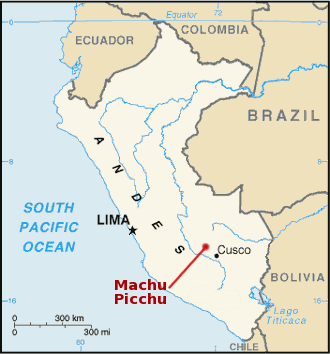
Machu Picchu (In Quechua language means Old Peak; sometimes called the “Lost City”) is a pre-Columbian city created by the Inca. It is located at 2,430 m (7,970 ft) on a mountain ridge above the Urubamba Valley in Peru, about 70 km (44 mi) northwest of Cusco. Forgotten for centuries by the outside world, although not by locals, it was brought back to international attention by archaeologist Hiram Bingham who rediscovered it in 1911, and wrote a best-selling work about it. Peru is pursuing legal efforts to retrieve thousands of artifacts that Bingham removed from the site. Machu Picchu is probably the most familiar symbol of the Inca Empire. Often referred to as “The Lost City of the Incas”, since 1983 the site has been designated as a UNESCO World Heritage Site.
Machu Picchu was constructed around 1450, at the height of the Inca empire, and was abandoned less than 100 years later, as the empire collapsed under Spanish conquest. Although the citadel is located only about 50 miles from Cusco, the Inca capital, it was never found and destroyed by the Spanish, as were many other Inca sites. Over the centuries, the surrounding jungle grew to enshroud the site, and few knew of its existence. It wasn’t until 1911 that Yale historian and explorer Hiram Bingham brought the “lost” city to the world’s attention. Bingham and others hypothesized that the citadel was the traditional birthplace of the Inca people or the spiritual center of the “virgins of the sun,” while curators of a recent exhibit have speculated that Machu Picchu was a royal retreat. Regardless, the presence of numerous temples and ritual structures proves that Machu Picchu held spiritual significance for the Inca.
It is thought that the site was chosen for its unique location and geological features. It is said that the silhouette of the mountain range behind Machu Picchu represents the face of the Inca looking upward towards the sky, with the largest peak, Huayna Picchu (meaning Young Peak), representing his pierced nose. In 1913, the site received significant publicity after the National Geographic Society devoted their entire April issue to Machu Picchu.
(Adapted from: Machu Picchu. From Wikipedia, The Free Encyclopedia.)
Click on any picture for a FREE larger version. Read the licensing rules (REVISED) for your needs. There are hundreds of high quality free photos: use the Google/site search engine. See our digital photography tips : DOs and Don’ts; Choosing a Camera and Accessories , Taking Digital Photos, Downloading Photos, and Editing Photos. Visit Climate Change Facts to see for yourself if you are at risk from global warming.


