Floreana (Charles or Santa María) was named after Juan José Flores, the first president of Ecuador, during whose administration the government of Ecuador took possession of the archipelago. It is also called Santa Maria after one of the caravels of Columbus. It has an area of 173 square kilometres (66.8 mi²) and a maximum altitude of 640 metres (2,100 ft). It is one of the islands with the most interesting human history and one of the earliest to be inhabited. The first governor of Galápagos, General José de Villamil, brought a group of convicts to populate the island of Floreana and in October 1832 some artisans and farmers joined. Pink flamingos and green sea turtles nest (December to May) in this island. The “patapegada” or Galápagos petrel is found here, a sea bird which spends most of its life away from land. At Post Office Bay, since 1793 whalers kept a wooden barrel that served as post office so that mail could be picked up and delivered to their destination mainly Europe and the United States by ships on their way home. There are coral formations at the “Devil’s Crown”, an underwater volcanic cone. The town of Puerto Velasco Ibarra is on the northwest part of the island and has restaurants and places to stay.
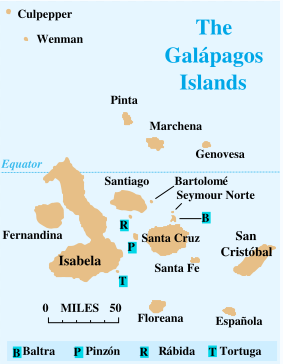
The Galápagos Islands (Official name: Archipiélago de Colón; other Spanish names: Islas de Colónumio or Islas Galápagos, from galápago, “saddle”—after the shells of saddlebacked Galápagos tortoises) are an archipelago of volcanic islands distributed around the equator, 965 kilometres (about 600 miles) west of continental Ecuador in the Pacific Ocean (1° S 91° W). The group consists of 13 main islands, 6 smaller islands, and 107 rocks and islets. The islands are located at a geological hot spot, a place where the earth’s crust is being melted from below by a mantle plume, creating volcanos. The oldest island is thought to have formed between 5 and 10 million years ago. The youngest islands, Isabela and Fernandina, are still being formed, with the most recent volcanic eruption in 2005. It is one of the few places in the world without an indigenous population. The Galápagos archipelago is a province of Ecuador, a country in northwestern South America, and the islands are all part of Ecuador’s national park system. They are famed for their vast number of endemic species and the studies by Charles Darwin during the voyage of the Beagle that contributed to the inception of Darwin’s theory of evolution by natural selection.
(Adapted from: Galapagos : Wikipedia, The Free Encyclopedia)
Click on any picture for a FREE larger version. Read the licensing rules (REVISED) for your needs. There are hundreds of high quality free photos: use the Google/site search engine. See our digital photography tips : DOs and Don’ts; Choosing a Camera and Accessories , Taking Digital Photos, Downloading Photos, and Editing Photos. Visit Climate Change Facts to see for yourself if you are at risk from global warming.


%20field%20used%20by%20tour%20boat%20crews%20at%20Post%20Office%20Bay,%20Floreana%20Island,Galapagos&from=post-office-bay-floreana-island-galapagos-islands-ecuador)


