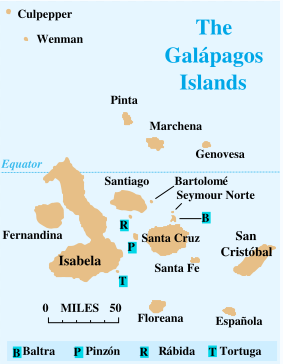
Named for Lt. David Bartholomew of the British Navy, this small island is located just east of Santiago Island. Desolate Isla Bartolomé is one of the most visited and photographed islands in the Galápagos. Bartolomé is an extinct volcano and has a variety of variably colored volcanic formations, including a tuff cone known as Pinnacle Rock. This large black partially eroded cone was created when lava reached the sea. Contact with seawater resulted in a phreatic explosion. The exploded molten fragments fused together forming a welded tuff. Isla Bartolomé is inhabited by Galápagos Penguins, sea lions, nesting marine turtles, white-tipped reef sharks and a variety of birds.
The Galápagos Islands (Official name: Archipiélago de Colón; other Spanish names: Islas de Colónumio or Islas Galápagos, from galápago, “saddle”—after the shells of saddlebacked Galápagos tortoises) are an archipelago of volcanic islands distributed around the equator, 965 kilometres (about 600 miles) west of continental Ecuador in the Pacific Ocean (1° S 91° W). The group consists of 13 main islands, 6 smaller islands, and 107 rocks and islets. The islands are located at a geological hot spot, a place where the earth’s crust is being melted from below by a mantle plume, creating volcanos. The oldest island is thought to have formed between 5 and 10 million years ago. The youngest islands, Isabela and Fernandina, are still being formed, with the most recent volcanic eruption in 2005. It is one of the few places in the world without an indigenous population. The Galápagos archipelago is a province of Ecuador, a country in northwestern South America, and the islands are all part of Ecuador’s national park system. They are famed for their vast number of endemic species and the studies by Charles Darwin during the voyage of the Beagle that contributed to the inception of Darwin’s theory of evolution by natural selection.
Photo of swimming beach and cove on Bartholomew Island (Isla Bartolomé), Galapagos Islands, Ecuador
Sharp, uneroded lava rocks and light weight cinders in piles on Bartholomew Island (Isla Bartolomé), Galapagos Islands, Ecuador
A pioneering plant, with spider webs growing in the lava rock on Bartholomew Island (Isla Bartolomé), Galapagos Islands, Ecuador
Sharp, uneroded lava rocks and light weight cinders in piles on Bartholomew Island (Isla Bartolomé), Galapagos Islands, Ecuador
Rugged, rocky coast, transitioning to a sandy swimming beach, and the Pinnacle Rock on Bartholomew Island (Isla Bartolomé), Galapagos Islands, Ecuador
Sally Lightfoot Crabs in the sun on the lava rocks. These crabs can jump from rock to rock and move rapidly.
A few pioneering plants amidst the volcanic ash on Bartholomew Island (Isla Bartolomé), Galapagos Islands, Ecuador
A boardwalk lifts tourists over a few pioneering plants and volcanic ash on Bartholomew Island (Isla Bartolomé), Galapagos Islands, Ecuador
Sharp, uneroded lava rocks and light weight cinders make most of Bartholomew Island (Isla Bartolomé), Galapagos Islands, Ecuador look as the surface of the moon
Trails from an old lava flow mark their path on a hillside on Bartholomew Island (Isla Bartolomé), Galapagos Islands, Ecuador
Sharp, uneroded lava rocks and light weight cinders in piles on Bartholomew Island (Isla Bartolomé), Galapagos Islands, Ecuador
Sharp, uneroded lava rocks and light weight cinders in piles on Bartholomew Island (Isla Bartolomé), Galapagos Islands, Ecuador
Sharp, uneroded lava rocks and light weight cinders in piles on Bartholomew Island (Isla Bartolomé), Galapagos Islands, Ecuador
A volcanic cone on Bartholomew Island (Isla Bartolomé), Galapagos Islands, Ecuador
Lava rocks and ash reach in all directions to the sea on Bartholomew Island (Isla Bartolomé), Galapagos Islands, Ecuador
Desolate desrt-like conditions on Bartholomew Island (Isla Bartolomé), Galapagos Islands, Ecuador
Grasshopper struggling to make a living on virtually plantless Bartholomew Island (Isla Bartolomé), Galapagos Islands, Ecuador
Tourists taking photos on Bartholomew Island (Isla Bartolomé), Galapagos Islands, Ecuador
A photovoltaic panel powers this navigation light on the top of Bartholomew Island (Isla Bartolomé), Galapagos Islands, Ecuador
Lava rocks and ash reach to the sea and Pinnacle Rock, with tourist boats at anchor on Bartholomew Island (Isla Bartolomé), Galapagos Islands, Ecuador
Lava rocks and ash reach to the sea opposite Pinncle Rock on Bartholomew Island (Isla Bartolomé), Galapagos Islands, Ecuador
A volcanic cone on Bartholomew Island (Isla Bartolomé), Galapagos Islands, Ecuador
Volcanic cones and lava rocks, ash and cinders on Bartholomew Island (Isla Bartolomé), Galapagos Islands, Ecuador
A volcanic cone on Bartholomew Island (Isla Bartolomé), Galapagos Islands, Ecuador
Volcanic cones and lava rocks, ash and cinders on Bartholomew Island (Isla Bartolomé), Galapagos Islands, Ecuador
Volcanic cones, uneroded lava rocks and light weight cinders in piles on Bartholomew Island (Isla Bartolomé), Galapagos Islands, Ecuador
Sharp, uneroded lava rocks and light weight cinders give the appearance of a moonscape on Bartholomew Island (Isla Bartolomé), Galapagos Islands, Ecuador
Sharp, uneroded lava rocks and light weight cinders give the appearance of a moonscape on Bartholomew Island (Isla Bartolomé), Galapagos Islands, Ecuador
Sharp, uneroded lava rocks and light weight cinders give the appearance of a moonscape on Bartholomew Island (Isla Bartolomé), Galapagos Islands, Ecuador
Sharp, uneroded lava rocks and light weight cinders give the appearance of a moonscape on Bartholomew Island (Isla Bartolomé), Galapagos Islands, Ecuador
A STOP sign, meant to be a viwing point for tourists, also gives a fair warning, on Bartholomew Island (Isla Bartolomé), Galapagos Islands, Ecuador
A pioneering cactus on desolate Bartholomew Island (Isla Bartolomé), Galapagos Islands, Ecuador
Tuna school working on bait fish off Bartholomew Island (Isla Bartolomé), Galapagos Islands, Ecuador
Large rock, showing cinder and solid rock all fused together on Bartholomew Island (Isla Bartolomé), Galapagos Islands, Ecuador
,%20Galapagos%20Islands,%20Ecuador&from=bartholomew-island-galapagos-islands-ecuador)
,%20Galapagos%20Islands,%20Ecuador&from=bartholomew-island-galapagos-islands-ecuador)
,%20Galapagos%20Islands,%20Ecuador&from=bartholomew-island-galapagos-islands-ecuador)
,%20Galapagos%20Islands,%20Ecuador&from=bartholomew-island-galapagos-islands-ecuador)
,%20Galapagos%20Islands,%20Ecuador&from=bartholomew-island-galapagos-islands-ecuador)

,%20Galapagos%20Islands,%20Ecuador&from=bartholomew-island-galapagos-islands-ecuador)
,%20Galapagos%20Islands,%20Ecuador&from=bartholomew-island-galapagos-islands-ecuador)
,%20Galapagos%20Islands,%20Ecuador%20look%20as%20the%20surface%20of%20the%20moon&from=bartholomew-island-galapagos-islands-ecuador)
,%20Galapagos%20Islands,%20Ecuador&from=bartholomew-island-galapagos-islands-ecuador)
,%20Galapagos%20Islands,%20Ecuador&from=bartholomew-island-galapagos-islands-ecuador)
,%20Galapagos%20Islands,%20Ecuador&from=bartholomew-island-galapagos-islands-ecuador)
,%20Galapagos%20Islands,%20Ecuador&from=bartholomew-island-galapagos-islands-ecuador)
,%20Galapagos%20Islands,%20Ecuador&from=bartholomew-island-galapagos-islands-ecuador)
,%20Galapagos%20Islands,%20Ecuador&from=bartholomew-island-galapagos-islands-ecuador)
,%20Galapagos%20Islands,%20Ecuador&from=bartholomew-island-galapagos-islands-ecuador)
,%20Galapagos%20Islands,%20Ecuador&from=bartholomew-island-galapagos-islands-ecuador)
,%20Galapagos%20Islands,%20Ecuador&from=bartholomew-island-galapagos-islands-ecuador)
,%20Galapagos%20Islands,%20Ecuador&from=bartholomew-island-galapagos-islands-ecuador)
,%20Galapagos%20Islands,%20Ecuador&from=bartholomew-island-galapagos-islands-ecuador)
,%20Galapagos%20Islands,%20Ecuador&from=bartholomew-island-galapagos-islands-ecuador)
,%20Galapagos%20Islands,%20Ecuador&from=bartholomew-island-galapagos-islands-ecuador)
,%20Galapagos%20Islands,%20Ecuador&from=bartholomew-island-galapagos-islands-ecuador)
,%20Galapagos%20Islands,%20Ecuador&from=bartholomew-island-galapagos-islands-ecuador)
,%20Galapagos%20Islands,%20Ecuador&from=bartholomew-island-galapagos-islands-ecuador)
,%20Galapagos%20Islands,%20Ecuador&from=bartholomew-island-galapagos-islands-ecuador)
,%20Galapagos%20Islands,%20Ecuador&from=bartholomew-island-galapagos-islands-ecuador)
,%20Galapagos%20Islands,%20Ecuador&from=bartholomew-island-galapagos-islands-ecuador)
,%20Galapagos%20Islands,%20Ecuador&from=bartholomew-island-galapagos-islands-ecuador)
,%20Galapagos%20Islands,%20Ecuador&from=bartholomew-island-galapagos-islands-ecuador)
,%20Galapagos%20Islands,%20Ecuador&from=bartholomew-island-galapagos-islands-ecuador)
,%20Galapagos%20Islands,%20Ecuador&from=bartholomew-island-galapagos-islands-ecuador)
,%20Galapagos%20Islands,%20Ecuador&from=bartholomew-island-galapagos-islands-ecuador)
,%20Galapagos%20Islands,%20Ecuador&from=bartholomew-island-galapagos-islands-ecuador)