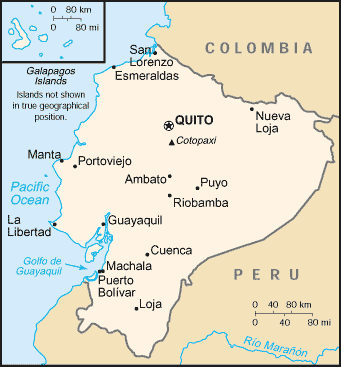
Santiago de Guayaquil, or just Guayaquil, is the largest and the most populous city in Ecuador, as well as the main port. Guayaquil is on the west margin of the Guayas River, which flows into the Gulf of Guayaquil in the Pacific Ocean. Guayaquil is about 250 km south-southwest of the capital of Ecuador, Quito. The estimated metropolitan population is about 3 million. Guayaquil is the capital of the Ecuadorian province of Guayas and the seat of the namesake canton. (In Ecuador, a cantón (canton) is a second-order subnational entity below a first-order province.) The city is the center of Ecuador’s fishing and manufacturing industries. The city’s new airport, Jose Joaquin de Olmedo International Airport (IATA abbr.: GYE), though using the same runways, had its passenger terminal completely rebuilt in 2006 and was renamed. The old passenger terminal is now a conference center.
Guayaquil was founded on July 25, 1538 with the name Muy Noble y Muy Leal Ciudad de Santiago de Guayaquil by Spanish Conquistador Francisco de Orellana. Even before it was founded by the Spanish, it already existed as a native village. Note – July 25 is the legal holiday in Guayaquil. Another possible founder might be Diego de Almagro. In 1600 Guayaquil had a population of about 2,000 people; by 1700 the city had a population of over 10,000. In 1687, Guayaquil was attacked and looted by English and French pirates under the command of George d’Hout (English) and Picard and Groniet (Frenchmen). Of the more than 260 pirates, 35 died and 46 were wounded; 75 defenders of the city died and more than 100 were wounded. The pirates took local women as concubines. Quito paid the ransom demanded by the pirates with the condition they release the hostages and not burn Guayaquil. In 1709, the English captains Woodes Rogers, Etienne Courtney, and William Dampier along with 110 other pirates, looted Guayaquil and demanded ransom; however, they suddenly departed without collecting the ransom after an epidemic of yellow fever broke out. In October 9, 1820, almost without bloodshed, a group of civilians supported by soldiers from the “Granaderos de Reserva”, a Peruvian battalion quartered in Guayaquil, overwhelmed the resistance of the Royalist guards and arrested the Spanish authorities. Guayaquil declared independence from Spain and José Joaquín de Olmedo was named Jefe Civil (Civil Chief) of Guayaquil. This would prove to be a key victory for the Ecuadorian War of Independence. On July 26, 1822, José de San Martín and Simón Bolívar held a famous conference in Guayaquil to plan for the independence of Spanish South America. The city suffered from a major fire in 1896 which destroyed large portions of the city.
(Text and map of Ecuador adapted from: Guayaquil. From Wikipedia, The Free Encyclopedia)
Click on any picture for a FREE larger version. Read the licensing rules (REVISED) for your needs. There are hundreds of high quality free photos: use the Google/site search engine. See our digital photography tips : DOs and Don’ts; Choosing a Camera and Accessories , Taking Digital Photos, Downloading Photos, and Editing Photos. Visit Climate Change Facts to see for yourself if you are at risk from global warming.


